
San Pedro Sourdough: fresh-milled grains, organic flour, community connection
In her home kitchen in San Pedro, California, Kate has been milling organic grains and baking slow-fermented sourdough breads for the last 7 years. She sells her grains, flours, and loaves through weekly pre-order pickups that keeps the business sustainable, focused, and deeply connected to her community.
A microbakery built on simplicity
At San Pedro Sourdough, Kate does everything from the milling to the kneading to the baking to the bagging by hand, in small batches. She focuses on a handful of breads that she knows well and makes consistently: a country loaf, a sesame loaf, a caraway rye, and a few other staples that regulars return for week after week.
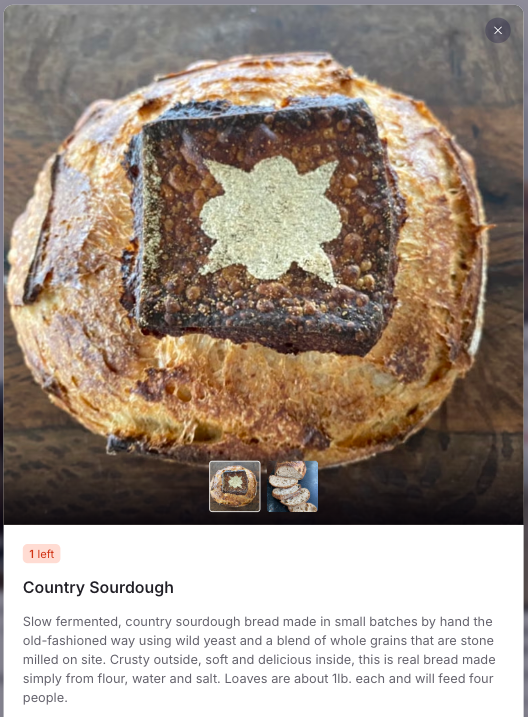
Earlier on, the menu offered more styles, more flavors, and more rotating specials, but over time, Kate realized that trying to do everything created unnecessary pressure for a very small operation. Maintaining all those selections as a tiny team was "really hectic." Narrowing the menu made it easier to protect quality while still giving customers enough variety to stay excited.
That is part of what makes San Pedro Sourdough feel like a true microbakery. It is small by design, not by accident. The goal is not to become an industrial bakery in miniature. It’s to keep making bread the old-fashioned way: with wild yeast, fresh-milled organic whole grains, water, salt, and time. The goal is to do a specific kind of work, with care, and to do it well.
What is a microbakery?
A microbakery is a small-scale, often home-based, baking business without a traditional storefront. In practice, that usually means lower volume, more hands-on production, and a closer relationship between baker and local customer.
San Pedro Sourdough fits that definition, but Kate adds another layer to it. She describes the business as a "vertically integrated microbakery." In other words, she is not only baking bread. She is also milling grains, flaking oats, sourcing chef-grade organic flour, organizing bulk grain buys, and helping connect other local bakers to ingredients they might not otherwise be able to access easily.
That gives the business a broader identity than just a bakery. It is part bread business, part grain resource, part education hub. Kate teaches monthly workshops, shares starters, talks with people about fermentation and flour, and invites customers deeper into the process. Her philosophy is not just "buy my bread." It is also, ideally, "learn how to bake your own."
Why freshly milled grains and organic flour matter
One of the clearest takeaways you’ll get from a conversation with Kate is that ingredient quality is not a marketing angle. It is the foundation of her business.
She talks about fresh-milled grains and organic flour in practical, sensory terms. Freshness matters because the flour has not been commodified and sitting on a shelf in a bag for months. Flavor matters because better flour improves the final product before you’ve added or done anything else. And sourcing matters because it gives people an alternative to the highly consolidated food systems that dominate grocery shelves.
For home bakers and bread customers alike, that framing is compelling. Fresh flour is not just a niche ingredient for professionals. It is a way to make everyday baking better. Kate points out that even adding 10 to 20 percent fresh-milled rye to biscuits, pancakes, flatbreads, or bread can completely change the result. The payoff is flavor, texture, freshness, and a stronger connection to the food itself.
That is also part of what gives San Pedro Sourdough a strong sense of place. One of the bakery’s standout loaves is a seaweed bread that Kate describes as "so unique and so San Pedro, a real food of place." It is a reminder that small bakeries can do something larger brands usually cannot. They can reflect the taste, culture, and identity of a specific community.
How San Pedro Sourdough got started
San Pedro Sourdough officially launched in 2019, but the story started years earlier, in a newly renovated kitchen.
Kate and her husband, both public school teachers, had finally managed to buy a house and slowly fix it up room by room. When the kitchen was finally done, she found herself oddly intimidated by it. Then she saw the cover of Tartine, with its now-famous loaf, and decided that learning to bake sourdough would be a way to "honor" the new kitchen.
What followed was the kind of origin story many bakers will recognize: obsession, repetition, and a steep learning curve. The constant trial and error, in her words, pushed her to become less rigid, more reflective, and more willing to learn by doing.
Like many cottage bakery stories, the business took shape because there was suddenly too much bread for friends and family to absorb. When a local restaurant owner ran out of bread on opening night, he tried the loaf that Kate had brought as a gift, and immediately sliced it up for customers. He later followed up to ask if they could serve it as their table bread. That moment gave Kate the push to "officialize" the business, move forward with the cottage setup, and create a real presence for San Pedro Sourdough.
She started an Instagram page while waiting for a flight at LAX. By the time she landed, someone had already messaged to ask how they could get her bread. Ever since, demand has been one of the defining realities of the business.
Why staying small became the strategy
For a while, Kate imagined San Pedro Sourdough might grow into something bigger. She experimented with different versions of the business, including a retail market stall and the idea of a brick-and-mortar shop. But after several years of trying different paths, she came to a different conclusion: what works best, both for her and for the community, is “doing a good job staying in a small bubble."
That phrase captures something important. Smallness is often framed as a stage that businesses need to outgrow. Here, it is more like a strategy. Kate is candid that scaling up would make it harder to maintain quality and could easily take over her life. Instead, she has found a sweet spot, maximizing what she can do within the size of the operation she actually wants.
That is one of the most useful takeaways for other microbakers. Growth does not always have to mean more products, more staff, more square footage, or more volume. Sometimes growth means clearer boundaries, stronger systems, and a better understanding of what kind of business you want to run.
How the weekly pre-order pickup works
San Pedro Sourdough runs on a weekly pre-order pickup model. The online menu opens over the weekend. Customers get a text when it is live and can place orders throughout the week. Ordering closes on Thursday morning, and pickup happens on Friday afternoon at Pepper Cafe inside Crafted at the Port of Los Angeles.
It is a simple system, but it does a lot of work.
For the customer, it creates a consistent rhythm. They know when ordering opens, when the menu closes, and when to pick up. For the baker, it makes production more predictable. She can plan the bake around actual demand instead of guessing, overproducing, or juggling last-minute back-and-forth.
That is one reason pre-order pickup works so well for a microbakery. Bread is perishable. Labor is finite. Energy matters. A weekly pickup structure lets a small baker stay organized without needing the complexity of a full retail setup.
For bakers trying to build a similar rhythm, Hotplate helps turn that weekly flow into a repeatable system, especially when the goal is to keep operations manageable without losing the personal connection that makes small food businesses special.
A local bakery with a strong sense of place
This is not just a sourdough business. It is a San Pedro business.
Kate talks about her local community with real affection, from the maritime character of the neighborhood to the people who carry their own bread traditions. She describes the joy of being able to connect with customers over a fresh loaf, helping them feel transported back to their own memories of bread.
That emotional resonance helps explain why small bakeries matter, especially in a time when so much food feels standardized and mass produced. A loaf of bread can still feel personal. It can still carry memory, place, and identity.
San Pedro Sourdough leans into that in a way that feels natural, not forced. The bakery is local not because it says it is local, but because the product, the pickup model, the ingredients, and the relationships all reflect the community it serves.
More than bread: classes, grains, and community
Another thing that makes San Pedro Sourdough interesting is that Kate has built more than one way for people to engage.
Some customers buy bread. Some come for flour or fresh-flaked oats. Some join a workshop to learn about starters, fermentation, grain, and mixing. Some are fellow bakers looking to participate in a bulk flour order.
That layered model is especially smart for a microbakery. It creates resilience without forcing the business into a generic growth path. Instead of adding dozens of SKUs or opening seven days a week, Kate has expanded by deepening the relationship customers can have with the bakery.
That is also part of why the brand feels credible. The business is not just selling a lifestyle. It is rooted in real practice, real expertise, and a real point of view about grain, bread, and food systems.
What other microbakers can learn from San Pedro Sourdough
There is no single formula for building a small bakery, but Kate’s story offers a few lessons that feel especially relevant right now.
First, a microbakery does not need a huge menu to build loyalty. In fact, a tighter menu makes consistency and strong operations possible.
Second, pre-order pickups are the most efficient operating model. It gives both the baker and the customer a clear weekly rhythm.
Third, ingredient philosophy matters, especially when it is specific and lived-in. Organic flour, milled grains, and long fermentation are not buzzwords here. They are the identity of the product.
And finally, staying small can be a deliberate choice. Not every successful bakery needs to become a storefront, a wholesale machine, or a larger production facility. There is also value in building a business that fits the life you want.
A bakery shaped by intention
The most memorable thing about San Pedro Sourdough is not just the bread. It is the clarity behind it.
Kate has tried different versions of the business and learned how to operate in a way that best serves her own lifestyle and her community. She’s arrived at a model that is grounded in what she does best. The result is a business that is focused, local, true to its values, and that is exactly what makes it thrive.
